
CASE 06 · Trainable
Recovery from a checkpoint
Result
Process one article and then stop, after which a new session reads long-task/progress.md to finish the two remaining articles; in the end all three articles are neither repeated nor skipped, and failed items are recorded.
Fixed materials
All three materials are short fictional texts; the progress template clearly separates the completed, already processed, failed, and next-step sections.
1. Prepare an Empty Task
cd ~/Downloads/pi-practice
mkdir -p long-task/source long-task/output
curl -fL https://pi.argakuka.com/en/examples/long-task/source/article-a.md -o long-task/source/article-a.md
curl -fL https://pi.argakuka.com/en/examples/long-task/source/article-b.md -o long-task/source/article-b.md
curl -fL https://pi.argakuka.com/en/examples/long-task/source/article-c.md -o long-task/source/article-c.md
curl -fL https://pi.argakuka.com/en/examples/long-task/progress-template.md -o long-task/progress.md
find long-task -type f -print
Windows users should replace the first line with cd ~/pi-practice. Before starting, there should be only three files in source and progress.md; if there are old files in output, move to a new directory and do not overwrite them to continue.
2. The First Session Handles Only One Article
pi --name "Checkpoint practice - first step"Send:
Read long-task/progress.md and long-task/source/article-a.md.
In long-task/output/index.md, use “## file name” as the level-two heading; on the next line write the title of the original text and a one-sentence summary,
then update the number of completed items, the files already processed, and the next step in long-task/progress.md.
Work on only this article, then stop and wait for my verification.
Exit Pi, open index.md and progress.md, and make sure the number of completed items is 1, the list contains only article-a.md, and the next step still points to material that has not been processed.
3. A New Session Recovers from the Checkpoint
pi --name "Checkpoint practice - recovery"Send:
Read long-task/progress.md first, then list the files in long-task/source that have not been processed.
Finish the remaining files one by one; in long-task/output/index.md keep using “## file name” as the level-two heading,
and each time an article is finished, update long-task/output/index.md and long-task/progress.md at the same time.
Do not repeat files already recorded as complete. If you find a damaged or unreadable file, record it in the failure list and then stop.
Key Symptoms
The recovery session reads the progress on disk first, rather than guessing how far the previous session got. Lesson 13 explains more about the limits of VPS and tmux.
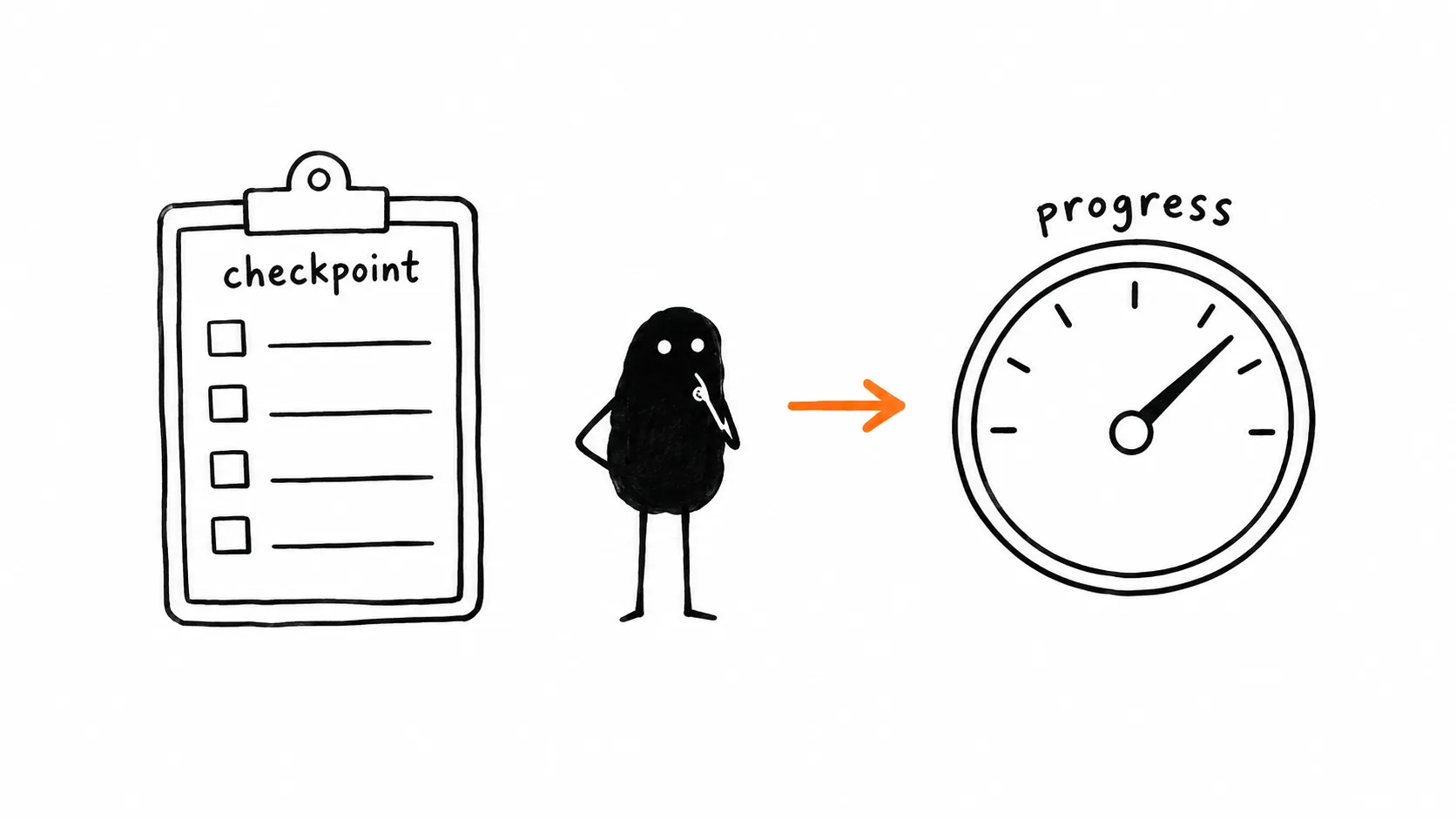
The recovery session reads progress.md first, and when it is done it checks the input count, the index, and the progress record against one another. Do not conclude that the task is finished just because “the session is still there”.
Independent Verification
find long-task/source -type f -name '*.md' | wc -l
grep -c '^## ' long-task/output/index.md
sed -n '1,180p' long-task/progress.md
The number of input files, the number of index entries, and the number of completed items in the progress are all 3; the list of processed files contains no duplicates, and the failure list matches reality. Also check the summary of each article one by one; do not just compare numbers.
Failure Recovery
After an interruption, read the existing progress and output first; do not blindly re-run from the start. If you find duplicates, preserve the field state, list the duplicate items together with where they came from, then decide on the fix; if a file is damaged, write it into the failure list and then stop.
Optional: Pi Durable
If you are going to build an Agent application that resumes tasks after its process is interrupted, continue with Pi Durable: keeping an Agent working after an interruption. It is an experimental framework, and the progress-file exercise already in this book can still be completed on its own. If you want to see the framework's automatic archiving take effect right away, continue with Optional case study: observing crash recovery with Pi Durable Assistant.